The Mali Empire: The Golden Age of Medieval West Africa
Introduction
The Mali Empire was one of the most powerful and wealthy empires in African history. Rising in the 13th century after the decline of the Ghana Empire, Mali dominated West Africa from approximately 1230 to 1600 CE. At its height, it controlled vast territories across modern-day Mali, Senegal, Guinea, Niger, Mauritania, and parts of Nigeria. Renowned for its immense wealth, sophisticated governance, and vibrant centers of learning, the Mali Empire became a global symbol of prosperity and intellectual achievement.
Origins and Foundation
The Mali Empire was founded by Sundiata Keita, often called the “Lion King of Mali.” According to oral traditions preserved by griots (oral historians), Sundiata defeated the Sosso king Sumanguru Kanté at the Battle of Kirina (c. 1235). This victory united the Mande peoples and marked the beginning of Mali’s imperial expansion.
Sundiata established a strong political foundation, including a constitution-like charter known as the Kouroukan Fouga, which outlined social organization, rights, and governance principles. This early legal framework contributed to political stability and economic growth.
Geographic Extent and Political Organization
At its height, the Mali Empire stretched from the Atlantic Ocean in the west to the Niger River bend in the east. Its vast territory was divided into provinces governed by appointed officials called farbas, who reported directly to the emperor, known as the Mansa.
The empire maintained a centralized monarchy supported by:
- Provincial governors
- Military commanders
- Court advisors
- Tax officials
The Mansa was considered both a political and spiritual authority, though Islamic influence increasingly shaped court practices.
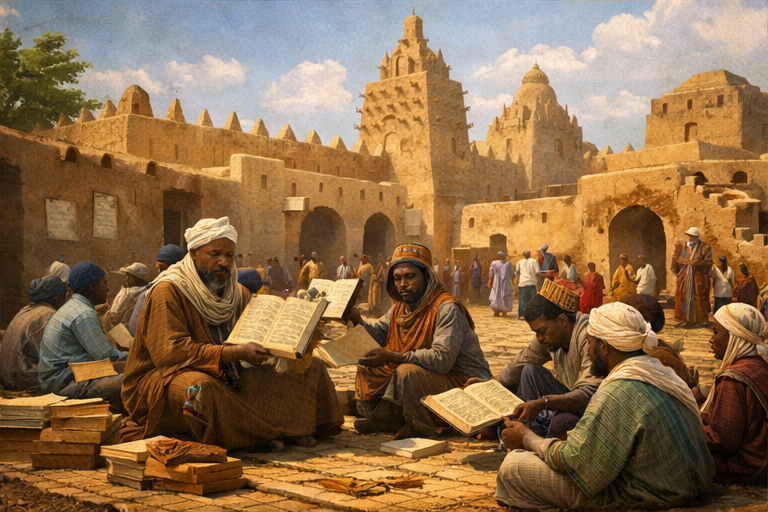
Tmbuktu Scholars
Economic Prosperity and Trade
The foundation of Mali’s wealth was its control of major trans-Saharan trade routes and its access to rich gold mines in Bambuk, Bure, and Wangara. Mali supplied a large portion of the world’s gold during the medieval period.
Major trade goods included:
- Gold
- Salt
- Copper
- Slaves
- Ivory
- Textiles
Cities such as Timbuktu, Gao, and Djenné became thriving commercial hubs. Mali taxed trade crossing its territory, creating enormous state revenue.
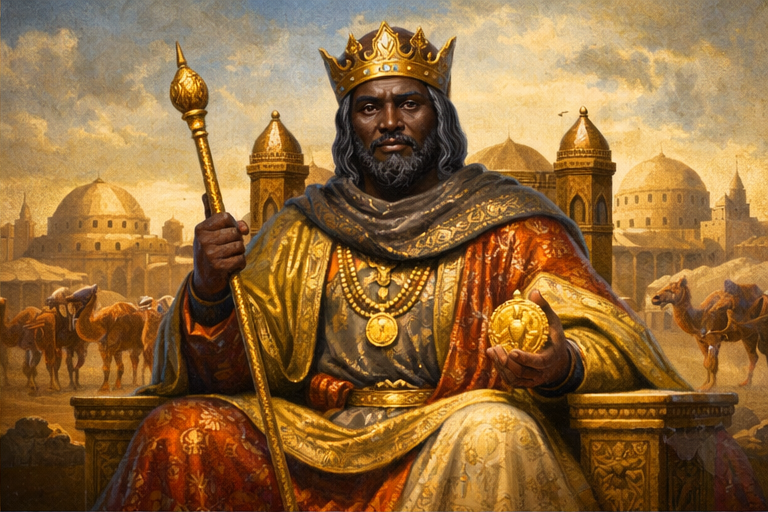
The most famous ruler, Mansa Musa (r. 1312–1337), exemplified Mali’s wealth. His pilgrimage to Mecca in 1324 displayed such extraordinary riches that it reportedly caused inflation in Cairo due to the vast quantities of gold he distributed.
AI Portrait of Mansa Musa
Religion and Intellectual Life
Islam played a central role in the Mali Empire, especially among the ruling elite. While many rural communities continued traditional African religious practices, the empire became a center of Islamic scholarship.
Timbuktu, in particular, gained international recognition as a center of learning. Institutions such as the Sankore University attracted scholars from across the Islamic world. Subjects studied included:
- Theology
- Law
- Mathematics
- Astronomy
- Medicine
Thousands of manuscripts were produced and preserved, many of which survive today as evidence of Africa’s rich intellectual heritage.
Military Strength
The Mali Empire maintained a powerful and well-organized army. Infantry units were equipped with bows, spears, and shields, while cavalry units played a decisive role in expansion and defense. Military strength allowed Mali to protect trade routes and expand into neighboring territories.
Cultural Achievements
Mali’s culture blended indigenous traditions with Islamic influences. Architectural achievements included:
- The Great Mosque of Djenné (rebuilt later but rooted in the Mali period)
- Mud-brick mosques and palaces
- Urban planning in trade cities
Oral traditions, epic poetry (especially the Epic of Sundiata), and music remained central to cultural identity.
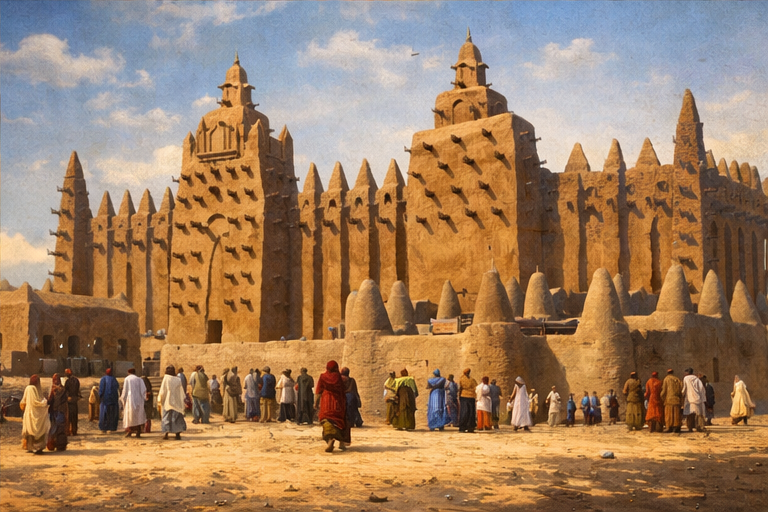
The Great Mosque Djenne
Decline and Fall
By the late 14th and 15th centuries, the empire began to weaken due to:
- Succession disputes and political instability
- Provincial rebellions
- Rise of the Songhai Empire, which captured key cities like Gao and Timbuktu
- Shifting trade patterns, including increasing Atlantic trade
By the 16th century, Mali had fragmented into smaller states and lost its dominance.
Legacy
The Mali Empire remains one of the most celebrated civilizations in African history. It demonstrated that complex governance, economic sophistication, and advanced scholarship flourished in Africa centuries before European colonialism.
Modern Mali draws cultural and historical pride from this empire, and Mansa Musa is still remembered as one of the wealthiest individuals in history.
Conclusion
The Mali Empire represented a golden age of West African power, prosperity, and intellectual achievement. Its legacy lives on in the preserved manuscripts of Timbuktu, the enduring Epic of Sundiata, and the historical memory of a civilization that shaped global trade and scholarship.